Nexus of Pathophysiology and Therapeutics (NPT) is an international, peer-reviewed journal publishing research in pathophysiology, biomedical sciences, pharmacology, and therapeutics, with a focus on disease mechanisms and clinical applications.

Serum Anti-Müllerian Hormone and IVF Outcomes: Associations with Oocyte Yield, Embryo Development, and Biochemical Pregnancy

Document Type : Original Research Articles

Authors

1 Department of Obstetrics and Gynecology, Faculty of Medicine, Lorestan University of Medical Sciences, Khorramabad, Iran.

2 Student, Student Research Committee, Lorestan University of Medical Sciences, Khorramabad, Iran.

3 Department of Social Medicine, School of Medicine, Lorestan University of Medical Sciences, Khorramabad, Iran.

Abstract
Background: Anti-Müllerian hormone (AMH) serves as an important biomarker for evaluating ovarian reserve and estimating the expected ovarian response to controlled stimulation in in vitro fertilization (IVF) cycles. Its relationship with pregnancy outcomes, however, remains less clear. This study examined the associations between serum AMH levels, ovarian response, and biochemical pregnancy in women undergoing IVF.
Methods: his observational analytical study included 221 infertile women undergoing IVF. Serum AMH and other reproductive hormones were assessed, and antral follicle count (AFC), numbers of retrieved oocytes and embryos, and serum beta-human chorionic gonadotropin (β-hCG) were recorded. Serum β-hCG concentrations were determined 16 days following embryo transfer. Associations between the study variables were examined using Spearman’s rank-order correlation analysis. AMH levels were compared between women with positive and negative biochemical pregnancy outcomes using the Mann–Whitney U test.
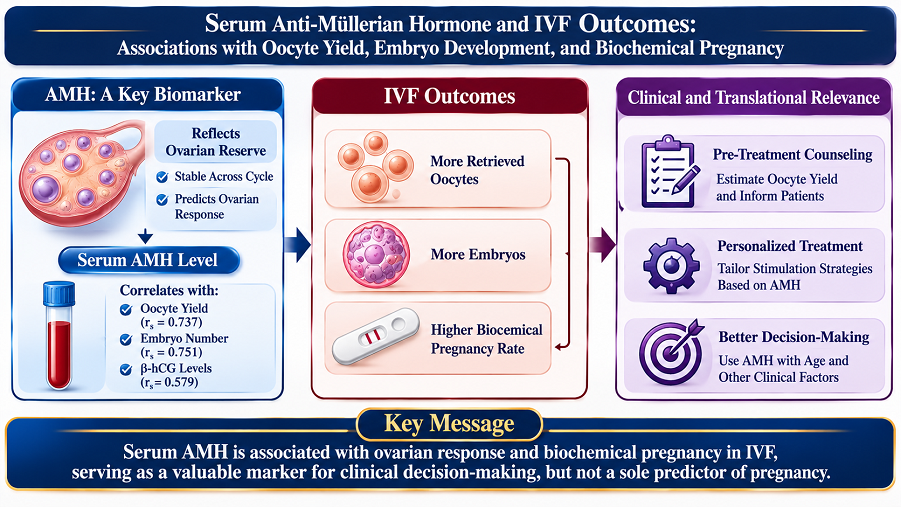
Results: Mean serum AMH was 1.70 ± 1.19 ng/mL. AMH was strongly and positively correlated with the number of retrieved oocytes (rₛ = 0.737, P = 0.0001) and embryos (rₛ = 0.751, P = 0.0001). A positive correlation was also observed between AMH and serum β-hCG (rₛ = 0.579, P = 0.0001). Women with positive biochemical pregnancy had higher AMH levels than those with negative results (2.836 ± 0.684 vs. 1.173 ± 0.996 ng/mL, P = 0.0001).
Conclusion: Serum AMH was associated with the quantitative ovarian response to IVF and with biochemical pregnancy status. These findings support its role in ovarian reserve assessment but do not establish its independent ability to predict pregnancy.
Clinical and Translational Relevance: AMH measurement may help estimate oocyte yield and inform counselling before ovarian stimulation. It should not be used alone to predict pregnancy or live birth; interpretation alongside maternal age and other clinical factors is warranted. Further studies with adjusted analyses and live-birth follow-up are needed.

Graphical Abstract

Serum Anti-Müllerian Hormone and IVF Outcomes: Associations with Oocyte Yield, Embryo Development, and Biochemical Pregnancy

Keywords

Subjects