
Nexus of Pathophysiology and Therapeutics (NPT) is an international, peer-reviewed journal publishing research in pathophysiology, biomedical sciences, pharmacology, and therapeutics, with a focus on disease mechanisms and clinical applications.
Document Type : Systematic Review
Authors
1 Irma Lerma Rangel School of Pharmacy, Texas A&M University, Kingsville, Texas, USA.
2 School of Global Studies, Oklahoma State University, Stillwater, Oklahoma, USA.
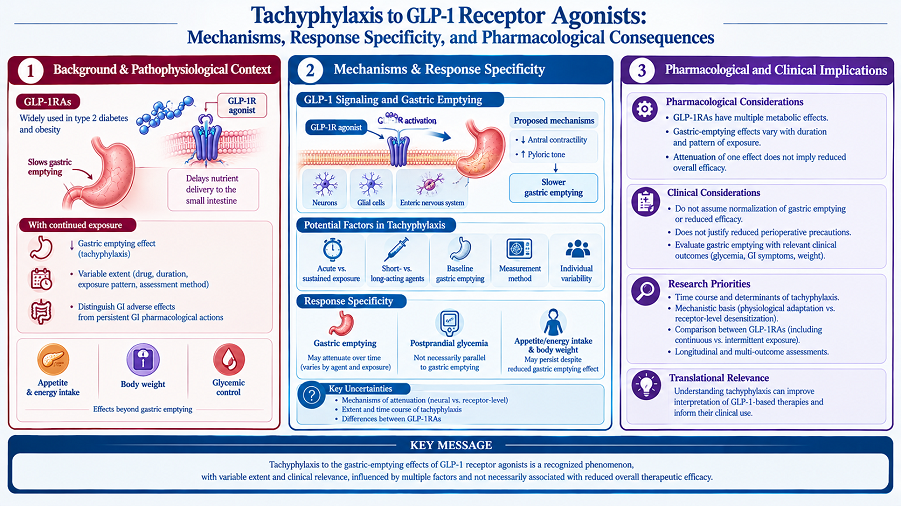
Graphical Abstract
Keywords
1. Introduction
Glucagon-like peptide-1 receptor agonists (GLP-1RAs) represent an established pharmacological approach to managing type 2 diabetes mellitus and obesity (1). In addition to their metabolic effects, these drugs slow gastric emptying, thereby delaying the delivery of nutrients to the small intestine (2). Glucagon-like peptide-1 (GLP-1) receptor agonists may reduce postprandial glycemic variability by delaying gastric emptying and attenuating postprandial hyperglycemia (3). An important feature of GLP-1-mediated control of gastric emptying is that the response may decline during continued exposure (4). This phenomenon, known as tachyphylaxis, has been observed with sustained GLP-1 administration (5). However, its extent and clinical relevance may differ according to the treatment, duration of exposure, and method used to assess gastric emptying (5). This variability is important when interpreting the gastrointestinal effects of GLP-1-based therapies, particularly because transient gastrointestinal adverse effects may not reflect the persistence of their pharmacological actions (6). Attenuation of the gastric-emptying effect does not necessarily indicate a corresponding loss of all therapeutic effects, because GLP-1 receptor agonists also influence appetite, satiety, and energy intake through central and peripheral mechanisms that are partly independent of gastric emptying (7). Moreover, the effects of GLP-1RAs on gastric emptying may vary with the duration and pattern of drug exposure (8). Taken together, these observations raise important pharmacological questions about the determinants of tachyphylaxis and its potential implications for treatment outcomes. This review critically examines the evidence for tachyphylaxis in the effects of GLP-1-based therapies on gastric emptying, evaluates potential contributing factors, and discusses the pharmacological and clinical implications of this response.
2. Physiological and Pharmacological Basis of Gastric Emptying
Gastric emptying is regulated by coordinated activity across the stomach, pylorus, small intestine, and autonomic nervous system (9). Gastric contractions promote the movement of contents toward the pylorus, while pyloric resistance and feedback from the duodenum control the rate at which nutrients enter the small intestine (10). Enteric neural circuits and vagal pathways contribute to this coordination (10). The rate of emptying also depends on meal composition and the physical properties of the ingested food (10). Within this regulatory system, GLP-1 contributes to the regulation of upper gastrointestinal motility, particularly by slowing gastric emptying (11). GLP-1 receptor agonists may delay gastric emptying by inhibiting antral contractility and increasing pyloric tone, thereby slowing the passage of gastric contents into the duodenum (12). These effects involve neural pathways and may vary with the physiological context and the pattern of GLP-1 exposure (12, 13).
The rate of gastric emptying influences the delivery of carbohydrates to the small intestine, where they are digested and absorbed (10). Rapid gastric emptying can accelerate glucose appearance in the circulation, whereas delayed gastric emptying can slow glucose absorption and attenuate or delay the early postprandial glucose rise (14). Gastric emptying is therefore one determinant of postprandial glycemia, although its contribution varies among individuals and is not the sole mechanism through which GLP-1-based therapies regulate glucose (15). Beyond these immediate effects on nutrient delivery and glycemia, an important pharmacological distinction is the difference between an acute response to GLP-1 and the response during sustained exposure (16). Acute activation of GLP-1 receptors slows gastric emptying, but this effect may attenuate during sustained exposure, consistent with tachyphylaxis (4). The response may depend on the duration and pattern of exposure, as well as the pharmacological properties of the intervention (4). This distinction between the acute and sustained effects of GLP-1 receptor activation provides the basis for examining the development of tachyphylaxis, as discussed in the following section.
3. Evidence for Tachyphylaxis During GLP-1-Based Treatment
Human studies indicate that the gastric-emptying–slowing effect of GLP-1 may exhibit rapid tachyphylaxis during sustained exposure, while the attenuation of this effect during chronic treatment varies among GLP-1 receptor agonists and appears more pronounced with long-acting agents (15). In a study of nine healthy volunteers, continuous intravenous GLP-1 infusion over 8.5 hours produced a significantly weaker delay in gastric emptying after the second meal than after the first, providing direct evidence of rapid tachyphylaxis of this specific GLP-1 effect (17). In a randomized trial involving 30 patients with type 2 diabetes, eight weeks of lixisenatide treatment increased gastric retention of a glucose drink compared with placebo, as assessed by scintigraphy. The treatment also reduced the rate of oral glucose appearance and postprandial glucose excursions. These findings support a sustained gastric-emptying effect with lixisenatide, although they do not establish that tachyphylaxis is absent in every patient or under all treatment conditions (18).
For long-acting agents, the evidence is more consistent with attenuation of the gastric-emptying effect over time, but the magnitude of this change is not uniform. In a 20-week trial of semaglutide 2.4 mg in adults with obesity, paracetamol absorption provided no evidence of delayed gastric emptying at the end of treatment. However, because gastric emptying was assessed indirectly and the study did not characterize the time course of adaptation during treatment, these findings cannot independently establish the occurrence of tachyphylaxis (19). Moreover, findings from different drugs should not be compared solely on the basis of treatment duration or half-life. Baseline gastric emptying is another important consideration. GLP-1-induced slowing tends to be greater when gastric emptying is initially faster (16). Conversely, pre-existing delayed emptying may limit the additional effect that can be observed, although this finding should not be generalized across all patient populations. These considerations highlight the need to interpret changes in gastric emptying in the context of both baseline physiological conditions and the limitations of the assessment methods used.
Beyond these limitations in interpreting gastric-emptying measurements, gastric emptying represents only one component of the physiological response to GLP-1-based therapies, and attenuation of this effect does not necessarily imply a parallel loss of their effects on appetite, energy intake, glycemic control, or body weight (16). Indeed, the persistence of clinically meaningful weight loss after 20 weeks of semaglutide treatment, despite no detectable delay in gastric emptying using an indirect assessment method, supports the contribution of mechanisms beyond delayed gastric emptying, particularly reduced appetite and energy intake, to its weight-lowering effects (19).
|
Aspect |
Key point |
|
Acute GLP-1 exposure |
The inhibitory effect on gastric emptying can diminish during continued exposure. |
|
Short-acting agents |
Effects on gastric emptying may remain evident during repeated treatment; the extent of tachyphylaxis requires direct assessment. |
|
Long-acting agents |
Gastric-emptying effects may attenuate over time, but the magnitude and time course are not fully established. |
|
Baseline gastric emptying |
Initial gastric-emptying rate may influence the magnitude of the observed treatment response. |
|
Measurement method |
Different assessment methods may yield results that are not directly comparable. |
|
Clinical interpretation |
Attenuation of gastric-emptying effects does not necessarily indicate reduced overall glycemic or weight-loss efficacy. |
Table 1. Key Considerations in Interpreting Tachyphylaxis to GLP-1-Based Therapies Abbreviations: GLP-1, glucagon-like peptide-1.
4. Mechanisms and Determinants of Tachyphylaxis
Tachyphylaxis to the gastric-emptying effects of GLP-1 is well documented, particularly during sustained GLP-1 exposure and treatment with long-acting GLP-1 receptor agonists (20). However, the mechanisms underlying this attenuation remain incompletely understood. Importantly, attenuation of a physiological response demonstrates a change in drug effect but does not, by itself, establish the underlying mechanism (17). The observed change may reflect physiological adaptation in vagal neural regulation or other components of gastric motor control (21). Nevertheless, the available human evidence does not establish the relative contribution of these processes. Evidence from human and animal studies suggests that vagal pathways contribute to the gastrointestinal effects of GLP-1, including the regulation of gastric emptying. However, the extent to which these pathways contribute to the attenuation of GLP-1-induced gastric slowing over time remains uncertain (22). Moreover, these findings do not establish the specific neural mechanisms underlying this attenuation. The inhibitory effect of GLP-1 on gastric motility persists after vagal deafferentation, suggesting that vagal afferent signaling is not essential for this effect (23). Thus, whether vagal mechanisms contribute similarly to the attenuation of gastric-emptying effects across individual GLP-1RAs remains unclear. Drug exposure is another relevant consideration. Short-acting and long-acting GLP-1 receptor agonists differ in their effects on gastric emptying, with a systematic review and meta-analysis suggesting a greater delay with short-acting agents; however, the certainty of this evidence was rated very low (24). These findings suggest that the effects of GLP-1RAs on gastric emptying vary according to drug duration of action and treatment duration (24). However, heterogeneity in study populations, treatment regimens, and gastric emptying assessment methods complicates direct comparisons (24). Moreover, the available evidence remains insufficient to characterize the time course and clinical significance of potential tachyphylaxis reliably (24). Against this background, an important distinction is between physiological tachyphylaxis and receptor-level desensitization. A reduction in the gastric-emptying response is consistent with tachyphylaxis but does not, by itself, establish receptor internalization, reduced receptor sensitivity, or altered intracellular signaling as the underlying mechanism (25). Such mechanisms require direct experimental evidence linking molecular changes to the observed physiological response. This distinction also supports a response-specific approach to interpreting tachyphylaxis. Changes in gastric emptying should be distinguished from other GLP-1 receptor-mediated effects, as the magnitude of gastric emptying delay does not necessarily correlate with changes in appetite or body weight (26). The physiological effects of GLP-1 receptor agonists may differ in their sensitivity to treatment duration and pharmacokinetic profile; therefore, attenuation of one response should not be assumed to imply a comparable decline in other responses (26). Accordingly, future studies should characterize the time course of individual physiological responses and distinguish observed adaptation from its proposed molecular mechanisms. This distinction may help clarify the pharmacological significance of tachyphylaxis and improve comparisons between GLP-1RAs.
5. Pharmacological and Clinical Consequences
The clinical implications of tachyphylaxis depend not only on the pharmacological response that attenuates but also on whether this attenuation meaningfully alters clinically relevant outcomes (5). In the context of GLP-1 receptor agonists, the persistence of residual gastric contents beyond the initial weeks of treatment illustrates why presumed tachyphylaxis cannot, by itself, justify reduced perioperative precautions (5). Gastric emptying is a major determinant of postprandial glycemia, partly by regulating the rate at which nutrients are delivered to the small intestine (27). Attenuation of GLP-1-mediated gastric slowing may reduce the contribution of delayed gastric emptying to postprandial glucose control, although glycaemic benefits may be maintained through other mechanisms (28). Changes in gastric emptying should not be interpreted as equivalent to changes in appetite or body weight, as these outcomes are related but distinct and may be influenced by multiple mechanisms (29). For example, in a 20-week trial, oral semaglutide reduced energy intake and body weight without evidence of delayed gastric emptying at the end of treatment, as assessed by the paracetamol absorption test (30). This finding illustrates that weight loss and the measured gastric-emptying response do not necessarily change in parallel. However, a single assessment at the end of treatment cannot establish whether earlier effects on gastric emptying had diminished over time or determine the extent to which gastric emptying contributed to the observed weight loss.
Gastrointestinal tolerability presents a similar interpretive challenge. Delayed gastric emptying may contribute to postprandial fullness and related symptoms, but it does not fully explain nausea and vomiting (31). Indeed, symptoms do not consistently correlate with gastric emptying, as symptomatic improvement may occur without a corresponding acceleration in gastric emptying (31). Consequently, symptom improvement or persistence alone is insufficient to establish whether tachyphylaxis has developed, which requires assessment of changes in the relevant pharmacodynamic response over time (16). These limitations in interpreting clinical responses also apply to the assessment of tachyphylaxis in clinical studies. Neither treatment duration nor gastrointestinal symptoms alone provide sufficient evidence to determine whether tachyphylaxis has occurred or to predict its clinical consequences (4, 17). Interpretation of gastric emptying measurements should account for the potential effects of medications and the methodological characteristics of the assessment, including the acquisition protocol and duration of imaging (32). To address these methodological and interpretive limitations, future studies should incorporate repeated assessments of gastric emptying alongside relevant clinical outcomes. Standardized test conditions and predefined assessment time points would help distinguish early pharmacodynamic effects from changes occurring during continued treatment. Such studies could establish whether attenuation of GLP-1-mediated gastric slowing is accompanied by clinically meaningful changes in postprandial glycemic responses or gastrointestinal symptoms. They could also clarify the extent to which changes in gastric emptying reflect the evolving pharmacodynamic response to treatment, rather than serving as a surrogate for the drug's overall clinical effects.
6. Tachyphylaxis as a Pharmacodynamic Challenge: Measurement, Interpretation, and Drug Comparison
Establishing tachyphylaxis requires more than demonstrating a weaker drug effect at a later time point, particularly because the time-dependent attenuation of GLP-1 receptor agonist–induced gastric emptying delay differs between short- and long-acting agents (33). The response should be evaluated longitudinally using comparable measurement methods and assessment conditions, while accounting for baseline gastric emptying (16). Otherwise, methodological differences, variation in assessment timing, and baseline physiological differences may confound the interpretation of an apparent reduction in drug effect as pharmacological adaptation (16). This distinction is important when interpreting evidence on GLP-1 receptor agonists (GLP-1RAs), as apparent differences in treatment effects must be considered in the context of the endpoints measured and the conditions under which they are assessed (34). Gastric emptying measurements are method-dependent, as scintigraphy directly assesses meal emptying, whereas paracetamol absorption provides an indirect estimate of gastric emptying (35). Consequently, differences in meal composition, test duration, and assessment timing may limit cross-study comparability and should be considered when comparing gastric emptying effects across GLP-1 receptor agonists (36).
A more informative approach is to assess gastric emptying at multiple time points within the same study. Longitudinal assessments before treatment initiation, during early exposure, and after sustained treatment could help characterize the magnitude and time course of attenuation in pharmacological responses (37). Consistent test conditions would strengthen these comparisons. Such a design would also help distinguish an initially smaller response from a genuine decline in response during treatment. Pharmacodynamic assessment should extend beyond gastric emptying alone, as gastric emptying is closely linked to postprandial glycemia and gastrointestinal symptoms (15). Accordingly, repeated assessment of gastric emptying, postprandial glucose profiles, and systematically recorded gastrointestinal symptoms may provide a more comprehensive evaluation of drug effects (38). These outcomes should be analysed separately before their relationships are examined. A change in gastric emptying does not, by itself, establish a corresponding change in glycemic control or gastrointestinal tolerability. These measurement and interpretation considerations also apply when comparing the magnitude of response attenuation across different GLP-1RAs.
Comparisons between GLP-1RAs require careful consideration of differences in study design, treatment duration, baseline characteristics, and outcome assessment, as heterogeneity in study populations may complicate comparisons across trials (39). Whether response attenuation differs between continuous and intermittent GLP-1 receptor agonist exposure remains an open question that requires direct comparative investigation using standardized assessment schedules (40). Until such evidence is available, apparent differences in tachyphylaxis should not be used alone to rank therapies or predict their overall clinical efficacy. The central methodological issue is therefore to distinguish three questions: whether a physiological response diminishes over time, whether the attenuation reflects pharmacological adaptation, and whether it changes a clinically relevant outcome. These questions are related but require separate evidence. Keeping them distinct would improve the interpretation of existing studies and help define more rigorous approaches to investigating tachyphylaxis in GLP-1-based treatment.
7. Research Priorities and Conclusion
Key priorities include determining whether the magnitude and time course of tachyphylaxis differ between GLP-1-based therapies and whether baseline gastric emptying influences these responses. Studies should also establish the extent to which attenuation of gastric-emptying effects translates into changes in postprandial glycemia, body weight, and gastrointestinal tolerability. Mechanistic investigations are needed to distinguish physiological adaptation from receptor-level desensitization, while longitudinal and comparative studies should clarify the temporal dynamics, interindividual variability, and clinical significance of response attenuation. Tachyphylaxis is an established feature of the gastric-emptying effects of GLP-1, but its determinants and broader clinical implications remain incompletely characterized. Addressing these gaps by integrating longitudinal physiological assessments with mechanistic investigations and clinically relevant outcomes will help define the extent and significance of this adaptation in response to GLP-1-based therapies.
8. Clinical and Translational Relevance
Tachyphylaxis to the gastric-emptying effects of GLP-1 receptor agonists has important implications for the interpretation of their pharmacological and clinical effects. Attenuation of gastric-emptying delay during continued exposure should not be assumed to indicate a proportional loss of glycemic or weight-loss efficacy, as these outcomes are also influenced by mechanisms beyond gastric emptying. From a translational perspective, this distinction highlights the need to evaluate gastric emptying longitudinally and alongside clinically relevant outcomes, including postprandial glycemia and gastrointestinal symptoms. A clearer understanding of the time course, determinants, and clinical significance of response attenuation may improve comparisons between GLP-1-based therapies and inform the interpretation of their gastrointestinal effects. However, presumed tachyphylaxis should not be used alone to infer normalization of gastric emptying or to determine perioperative management, which requires consideration of the individual patient's clinical context and relevant procedural guidance.
Data Availability Statement
No new data were generated or analyzed in this review. All information discussed is available from the sources cited in the manuscript.
Conflict of Interests
The authors declare that they have no conflicts of interest.
Author Contributions
The authors contributed to the conception and design of the review, literature search, data interpretation, and manuscript preparation. The authors critically revised the manuscript, approved the final version, and agree to be accountable for all aspects of the work.
Ethics Statement
All ethical considerations, including plagiarism, data fabrication, and duplicate publication, have been fully observed by the authors.
Acknowledgement
The authors thank all individuals who contributed to the completion of this work.
Declaration of Generative AI and AI-Assisted Technologies
No generative artificial intelligence or AI-assisted technologies were used in the preparation of this manuscript.
Publisher's Note
The graphical abstract was prepared by the journal's editorial team using artificial intelligence-assisted design tools and was reviewed and approved by the authors prior to publication.

