Document Type : Original Research Articles
Authors
1
Student Research Committee, Lorestan University of Medical Sciences, Khorramabad, Iran.
2
School of Global Studies, Oklahoma State University, Stillwater, Oklahoma, USA.
3
Department of Biostatistics and Epidemiology, Nutritional Health, Lorestan University of Medical Sciences, Khorramabad, Iran.
4
Department of Internal Medicine, School of Medicine, Lorestan University of Medical Sciences, Khorramabad, Iran.
Abstract
Background: Ursodeoxycholic acid (UDCA) dissolves selected cholesterol gallstones, but treatment response varies. Whether adding cholesterol-lowering agents improves dissolution remains uncertain. This trial compared UDCA alone with UDCA plus atorvastatin or ezetimibe in patients with asymptomatic gallbladder stones.
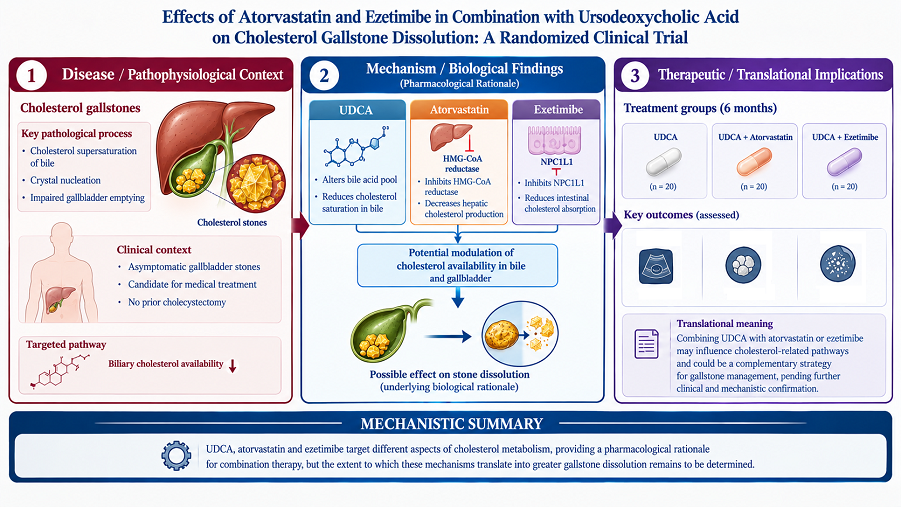
Methods: In this three-arm randomized clinical trial, 60 participants were assigned to UDCA (600 mg/day) alone, UDCA plus atorvastatin (20 mg/day), or UDCA plus ezetimibe (10 mg/day) for six months. Following one withdrawal, 59 participants were analyzed. Ultrasonographic outcomes included total gallstone length, stone number, and treatment response. Complete response was defined as no visible stones; partial response required a reduction of at least 50% in stone size without complete disappearance.
Results: Mean total gallstone length decreased from 21.42 to 12.10 with UDCA alone and from 18.02 to 10.65 with UDCA plus atorvastatin, compared with a reduction from 25.55 to 24.95 with UDCA plus ezetimibe. The reported baseline-adjusted analysis indicated an overall between-group difference (P = 0.015). Complete response rates were 47.4%, 60.0%, and 15.0%, respectively. Treatment-response distributions differed among groups (P = 0.005), whereas changes in stone number did not (P = 0.136). Pairwise comparisons did not establish a significant difference between UDCA alone and UDCA plus atorvastatin.
Conclusion: UDCA alone and UDCA plus atorvastatin showed reductions in mean stone length, whereas the ezetimibe combination had a less favorable descriptive response. Neither combination was established as superior to UDCA alone.
Mechanistic and Translational Relevance: UDCA modifies biliary cholesterol saturation, whereas atorvastatin inhibits cholesterol synthesis and ezetimibe reduces intestinal cholesterol absorption. These distinct mechanisms do not necessarily translate into equivalent improvements in gallstone dissolution.
Graphical Abstract
Keywords
Subjects